

M12IS GNSS Receiver
The M12 IS GNSS Receiver is an advanced surveying solution integrating GNSS, IMU tilt, and vision technology with dual cameras for 3D modeling and imaging in hard-to-reach or signal-obstructed areas. Its advanced vision system allows surveyors to remotely measure points up to 10 meters or more, reducing the need for physical access in dangerous or challenging environments.
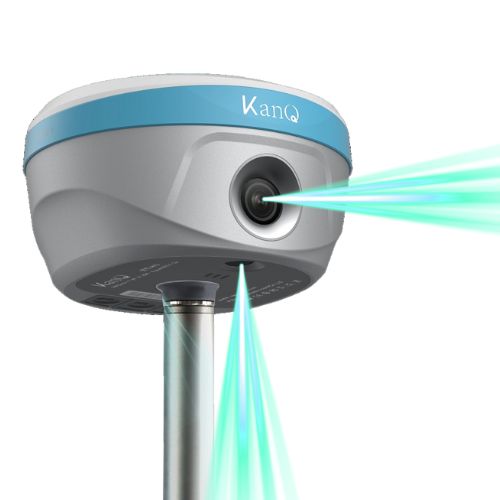
With 1408 GNSS channels, full-frequency RTK, 120° IMU tilt, and immersive AR stakeout, the M12 IS delivers high precision, robust performance, and efficient field operation. Multi-connectivity via 4G/2W radio, Bluetooth, WiFi, and LoRa ensures seamless data transfer and a working distance of up to 12 km.
M12IS GNSS Receiver
Super Tracking Capability: 1408 GNSS channels with full-frequency RTK engine and full-star technology for reliable performance in complex conditions.
Vision Survey Technology: Dual cameras and imaging sensors allow remote point measurement, reducing physical effort and increasing efficiency.
AR Stakeout: Immersive AR display vividly shows ground stakeout points in software, improving field productivity.
Robust & Durable: IP68 protection, over 30 drop tests from 2 meters, and water immersion resistant.
IMU Tilt 120°: 4th-generation sensor for accurate tilt measurements without recalibration.
Powerful Battery: 7.4V, 7000mAh with USB Type-C fast charging and power bank support; 24–26 hours continuous operation.
Multi-Connectivity: 4G LTE, Bluetooth 5.0, WiFi 802.11, Radio, and LoRa up to 12 km.
High Update Rate: Supports up to 50Hz data update for fast and efficient surveying.
Versatile Models: Choose from M12 Basic, M12 LA (Laser), or M12 IS (Imaging Sensor & 3D Modeling) based on your project requirements.
The M12 IS is designed for surveyors and engineers who need high-precision imaging, 3D modeling, and remote measurement capabilities in demanding field conditions.
M12IS GNSS Receiver
| Specification | Details |
| Channels | 1408 |
| GPS | L1C/A, L2P(Y), L2C, L5 |
| Glonass | L1/L2 |
| BDS | B1/B2/B3/BIC/B2a/B2b |
| Galileo | E1/E5a/E5b/E6 |
| QZSS | L1/L2/L5/L6 |
| SBAS | L1 |
| NavIC | Yes |
| Data Format | RTCM2.X, RTCM3.X, NMEA 0183 |
| Data Update Rate | 50 Hz (max) |
| Initialization Time | <5s (Typically) |
| Initialization Reliability | 99.99% |
| Positioning Accuracy | RTK: H ±8mm+1ppm, V ±15mm+1ppm |
| DGPS Accuracy | H ±0.4m, V ±0.8m |
| Single Point Accuracy | H ±1.5m, V ±2.5m |
| IMU Accuracy | 20mg; Angle H ±2.5mm+1ppm, V ±5mm+1ppm |
| Speed Accuracy | 0.03 m/s |
| Laser/Camera Accuracy | 2–4 cm at 10m (95% under normal lighting) |
| AR Stakeout | Immersive visual stakeout display |
| Communication | Bluetooth 5.0, WiFi 802.11 b/g/n, LTE, Radio, Lora |
| Radio Protocol | Trimtalk450s, Trimmark III, South9600/19200, Lora |
| Communication Range | Standard 5 km; Lora up to 12 km |
| Battery | 7.4V, 7000mAh; Quick charge & USB Type-C |
| Working Time | 24–26 hours |
| Charging | USB 15V/2A Quick Charge |
| Operating Temperature | -45°C to 75°C |
| Storage Temperature | -55°C to 85°C |
| Protection Level | IP68 |
| Physical Size | 129 x 129 x 77 mm |
| Weight | 850 g |
| Ports | 1x USB Type-C, 1x SMA UHF antenna, 15-pin LEMO (9V–14V) |
| Camera | 5MP dual camera for imaging and AR stakeout |
| Memory | 32 GB |
| Remark | M12 Basic, M12 LA (Laser), M12 IS (Imaging & 3D Modeling) |
M12IS GNSS Receiver
- Land surveying and mapping in difficult or obstructed areas
- Construction and civil engineering projects
- 3D modeling and imaging for geospatial analysis
- AR-assisted stakeout and visual surveying
- Infrastructure monitoring and inspection
- Remote measurement in hazardous or hard-to-reach fields
M12IS GNSS Receiver?
Reliable Precision: Multi-frequency RTK and imaging sensor for centimeter-level accuracy
Robust & Rugged: Designed for extreme field conditions with IP68 protection
Advanced Vision & AR Technology: Reduces physical effort and improves workflow efficiency
Cost-Effective: High-spec GNSS and imaging technology at a competitive price
Flexible Communication: Lora, LTE, Bluetooth, and WiFi for seamless integration
Versatile Models: Fits surveying, 3D modeling, and remote measurement requirements